The New Rewild.info!

Up and running. Want to run a rewild camp or open space in your place? This is the site for you!

www.rewild.info

Echoes in Time Video

This is a video about Echoes in Time, the gathering I volunteer at. See my previous post for more info on the next gathering.

Echoes in Time: Workshops in Early Living Skills

www.echoes-in-time.com

“Join us for our 10th annual gathering! Workshops include early living skills and primitive crafts from the stone age era through the pioneer era. The workshops are meant to appeal to people with historical and sustainable interests – mountain men, outdoorsmen, rewilders, permaculturalists, families, boy scouts, homeschoolers and abos. However, anyone is invited to register. No previous knowledge or experience is required. In fact, if you have a particular field of interest not mentioned, let us know when registering and we’ll do our best to accommodate your curiosity. Plan to register early as space is limited. Come prepared to learn amid a circle of enthusiasm and new friends. We look forward to one and all” - Echoes Staff

Hosted by Dale Coleman, Goode Jones, Leland Gilson
Monday, July 20, 2009 - Friday, July 24, 2009 at 5:00pm
Location: Willamette Mission State Park (Exit 263 of I-5 just north of Salem, Oregon)
Phone: 503.873.4055
Email: echoesintime@aol.com
Cost: $175 before June 30th 2009
Single Day Rate: $40 per person
Fees include park camping, insurance and instruction.

To register to go www.echoes-in-time.com

Some Courses offered:
• Fire by friction, flint & steel
• Flintknapping
• Stone tools & bowls
• Bone & antler tools
• Bows & arrows
• Atlatls
• Braintanning hides
• Rawhide containers
• Moccasins
• Hafting
• Cordage
• Plant walks
• Gourd work
• Soap making
• Felting
• Dying & weaving
• Fiber crafts
• Drop spindle
• Quill work
• Scrimshaaw
• Beading
• Blacksmithing
• Sustainable living

The Vegetarian Myth by Lierre Keith

Part memoir, nutritional primer, and political manifesto, this controversial examination exposes the destructive history of agriculture—caused the devastation of prairies and forests, driven countless species extinct, altered the climate, and destroyed the topsoil—and asserts that, in order to save the planet, food must come from within living communities. In order for this to happen, the argument champions eating locally and sustainably and encourages those with the resources to grow their own food. Further examining the question of what to eat from the perspective of both human and environmental health, the account goes beyond health choices and discusses potential moral issues from eating—or not eating—animals. Through the deeply personal narrative of someone who practiced veganism for 20 years, this unique exploration also discusses alternatives to industrial farming, reveals the risks of a vegan diet, and explains why animals belong on ecologically sound farms.

http://www.amazon.com/Vegetarian-Myth-Food-Justice-Sustainability/dp/1604860804

The Real Suburban Scout?

If you’ve ever seen my 2004 film short, The Adventures of Urban Scout, you know that in the film I had an imaginary arch-enemy by the name “Suburban Scout.” He was trying to appear like me, Urban Scout, but only for the aesthetic and not the rewilding angle. The other day I picked up the Portland Tribune and turned to the “Sustainable Life” section (which I do from time to time for a good laugh or to get myself pissed at what they pass as sustainability) and saw a hilarious article on the front page entitled “Suburban Tepee” with the laugh-out-loud, ludicrous subtitle; “Commodities Broker Longs for Life Close to the Earth.” This guy looks like an honest to god, real life, Suburban Scout!

Of course, the article was boring and stupid and had nothing to do with sustainability what-so-ever. In fact, it had nothing to do with anything interesting, except to say that some rich douche in the upper crust suburb Lake Oswego sleeps in a tipi in his parents backyard at night, and by day works as a commodities broker at daddies company and spent his richie rich childhood traveling to exotic places (he even has a hippopotamus skin!).

“He says he’s no radical and isn’t trying to send a political message. He’s just trying to live nearer to nature.” What the fuck? They put him on the cover of the sustainability section and he has nothing to say about sustainability. Dude, what the fuck does “close to nature” even mean anyway? I can only assume it means living more sustainably, since he’s on the cover of the sustainable life section. How is sleeping in a synthetic tipi (what is that, carpet on the ground???) with chemically tanned hides of animals from a different continent getting you closer to nature or making you more sustainable? Living close to nature, living more sustainably, doesn’t mean standing or sitting or sleeping outside or close to plants or mimicing superficial indigenous customs from a completely different bioregion. Sleeping in a tipi has absolutely nothing to do with sustainability. NOTHING. Unless you’re a plains Indian living 300 years ago and even then the tipi is a bi-product of their sustainable land management practices. Hey Portland Tribune, my buddy Willem slept outside in his backyard for a year. Why isn’t he on the cover of the “sustainable” section? Fucking HOMELESS people sleep outside, in tents all year, all the time. Why aren’t THEY on the cover of the sustainable section? If sleeping in a tent is so fucking sustainable… I mean really. Oh right. They’re not rich assholes who continue the status quo of destruction.

Indigenous people live “close to nature” not because some of them sleep in tipis or wear the skins of animal or practice spiritual customs. They live sustainably because they manage the land in a sustainable way. Everything else about their culture is a bi-product of that. Want to live “close to nature?” You should read about how indigenous peoples of this region live and connect with nature in real-life ways, and then replicate their land management practices. It makes me wonder how and why this article was even in the paper? I mean… Did Paulson Commodities pay the tribune or something? Could it be that the author is a friend of the Paulsons and was bored? It has to be one of those two things… if not, just fucking shoot me. We’re fucked.

I can’t claim that I’m more pure than he is; anyone who works in the civilized economy is fucking up the planet somehow. But at least I’m saying something and challenging the status quo of destruction and exploitation. At least I’m working to dismantle civilization in the ways that I know how. And while I’m still very much dependent on the grocery store for food, at least I’m working to create a different world and making it clear that this culture is fucked up. The fact that there is abso-fucking-lutely nothing sustainable or interesting about some rich dude sleeping in a tipi, and that he’s on the cover of the sustainable section continues to blow my mind. Fuck the Portland Tribune and fuck “sustainability.” What really gets me about him is his hodgepodge, world-collection of indigenous artifacts and customs, this smorgasbord of cultural appropriation; an African animal skin, mid-western Indian shelter, and a white mans alleged version of southwestern Indian spirituality (the whole Tom Brown Jr. “Lipan Apache Shamanism” thing). Without a political message about sustainability, he is just another rich eccentric with a fetish for native peoples belongings and customs. A commodities broker who collects the commodities of broken indigenous cultures… How unique. And sustainable. Let’s put him on the cover!

Dandelion Wine Prep

Continue reading ‘Dandelion Wine Prep’

Garden Rambo in “Last Frost”

When I got back from L.A. last week, my yard was exploding with life and new growth. Everything I planted last year survived and is now waking up from its winter slumber. I looked back at my blog from a year ago, and another from a month later to see what progress I can make this year. But first, here is a photo update on the plants from last year!

As you can see in the following photo, the cattails have exploded with new growth. I counted 29 or 30 new shoots. I think we had half that last year, and that was after a transplant. The rhizomes have actually grown into the grass and out of the aquatic pool I dug, because the ground is so wet right there (which is why I dug it out to begin with).

The Kiwis are leafing out which is awesome. I’m going to put a longer pole in for them to climb. I’m going to train them up the play structure but they need to get a little longer first.

I thought the arctic raspberries would die off, but they came back with a vengence! I kept checking over the last few weeks as the mustards and dead nettles came up, but didn’t see anything. I was so excited to come back from L.A. and see them all over the place! Hopefully I’ll be able to try their fruit this year.

The salmonberries looks terrible at the end of the year and a bunch of the branches died. But look at them now! Hopefully they will get nicely established and flower this year?

I was also worried the camas wouldn’t come back but there it is! With a few new growths too! It’s already sending up its flower stalks on most of the plants. I’m guessing the first year ones are the ones without flower stalks.

The baby Willamette Valley Pine has doubled in size, boasting four branches and counting!

I weeded this little area and transplanted some yarrow babies from the grass, since that usually gets cut by the mower, I had no idea yarrow was growing there. I don’t know how well they will handle the transplant. Their roots seems very established (fighting with the grass roots). Which confused me because I thought they were annual, not perrenial. I’m wondering if they die only after they flower and go to seed, so if they don’t get the opportunity… do they keep living? I realize that may sound stupid but I’m also realizing I don’t know much about plant growth. I planted the yarrow in a circle around whatever the hell that thing in the middle is. My mom said she didn’t plant it, but it looks like an ornamental that was intentionally placed there by the spacing, so I didn’t weed it.

So that’s most of what I planted last year, plus the yarrow I just transplanted. Oh, the Pear tree is doing well. I forgot to prune it last fall, so I’ll definately want to do that this fall. Ron finished the green house, so that will be available for sprouting this year and winter greens this winter.

Next up is to weed out the garden and plant the seeds. I’d like to fill in the rest of the water feature with cattail rhizomes. I think I’m going to buy a bunch more Camas and put it around the pine. I’d also like to plant some wild onion around the marshland. I need to sit down with my parents and draw up a plan for this year.

California Knows How to… Rewild?

What can I say? I love L.A. Yes, it’s a tumorous growth on the flesh of the mother. Yes, it’s a cesspool of everything I hate. Yes, “the only way to fix it is to flush it all away.” And yet… There is so much I love about Los Angeles and I’m not just talking about the champagne parties that take place in roof top hot tubs (which are fucking awesome by the way)!

I recently spent a week in L.A. mainly for an interview with Flaunt Magazine about rewilding but also to hang out and connect with old friends. While there I thought a lot about the rejection of culture and people that takes place when an individual realizes how fucked up civilization is. So often people think that culture and civilization are synonymous. In our mythology we are taught to think that civilization owns music, art, science, spirituality, fashion, language and thought. It’s natural, I suppose, to feel so much grief and so much guilt for the way we live our lives that we distance ourselves as far as possible from anything that looks like it might be a product of civilization. I know, cause I did this along with many other of my friends. I also distanced myself from my friends and family who didn’t understand, or care to understand, rewilding.

I have a lot of anti-civ friends and colleagues. But I’m pretty sure the majority of my friends these days are not anti-civilization and are not even into rewilding (although deep down I think everyone is an anti-civilizationists, it is our birthright after all to be wild and free!). I don’t ever really talk about my views with most of my friends because I don’t really care about converting any of them. I rewild with the ones who are into rewilding. I usually choose my friends not by their level of interest in rewilding, but by those who show sincere support for me and that make me laugh. If people are curious about rewilding, I will talk about it with them and invite them along when I do rewildy-type-thingys. Hell these days everyone’s into self-sufficiency anyway, so it’s not that great of a leap.

A lot of my critics (who never took the time to understand rewilding) tell me that if I hate civilization so much than why don’t I go live in the wilderness. Over and over again I have to explain that rewilding is not about living solitary in the wilderness with no culture. It’s about artistically restoring family and connecting family to land using indigenous land management practices; it’s about creating more life. That’s it. It reminds me of something Martin Prechtel once said, which was something like “It’s not about stopping the rate of destruction, it’s about speeding the rate of creation.” You can create more life anywhere really. While living in the wilderness would feel great in a lot of ways, it often also feels alienating in a different way. This is because people leave behind people and culture when they go into the woods.  Cities, being the apex of domestication, are in dire need of rewilding, perhaps more so than wilderness (while the “wilderness” is in more need of culture).

L.A. is no exception. As a nexus of money, culture and creativity, L.A. has so much potential for creating beauty and life. It is a powerful, creative space. Er… Of course that power is fueled by industrial civilization, and most of the creative energy is used to create mythology that furhter inculcates the slaves of this death culture… but there is still room for rewilding! I swear! With the right amount of pressure, in the right place, the right rewilder could really leverage that power into something much much more beautiful and life-giving. That’s why I love L.A. It’s weakness and it’s strength are the same thing. I also recognize it is not a tool to take lightly. My old friend Chris Shaeffer once said something like, “The ‘creative’ industry is like a very powerful tool, that is covered in shit. Sure, you may work your way up to using it, but you’re going to have to get shit all over your hands in the process.” I couldn’t agree with him more, and yet I still see beauty in it. Even though my hands are covered in shit… um, anyone got some baby wipes?

So, back to my trip… Flaunt magazine interviewed me and a few friends who live there about rewilding. I didn’t quite know what to expect so I brought my friend Hannah with me so that I could escape if it got too weird. The following are the photos (mostly taken by Drury) from the weekend.

Hannah and I arrive on the scene:
Arriving on the scene

The hike in. Yes, this is in the middle of L.A. WTF? The Beautiful Topanga Canyon!

Almost immediately things took a turn for the awesome when we drank a LOT of whiskey and I turned into Bourbon Scout. T is for Topanga Canyon motha fucka!!!

The next thing I remember it was the next day and I had a terrible hang over. I guess the interview went well? Mesculin Cacti anyone? Duhhhh. Good thing my friend Bill Maxwell was there to keep things grounded.

Rob and I took Jenny and Drury (the Flaunt Peeps) out foraging in spite of the collective hangover and rob showed me lots of the wild California plants.

Meanwhile my friend Erin started work on a garden for Drury.  Days later, her dog Munka would eat my brain-tanned roadkill raccoon hat.

After a good hour or so the foraging trip fizzled out under the hot sun and the collective hang-overs so we went back to the shade and chatted more about rewilding and other crap.  RIP Raccoon hat!

The highlight of my trip was when my friend Bill Maxwell took me and Susan to a sweat lodge. It was a great lodge. I was also able to catch up with my buddy Rob and do an interview for a documentary he’s shooting about people preparing for the apocalypse. We walked through the Hollywood hills and went by Lake Hollywood which is actually a very beautiful little spot. It was really nice catching up with him. My friends Davey and Susan took me out for my birthday. After avoiding an angry crowd of hostile hipster at the Short Stop we got some awesome photobooth pics for only $2 at the Cha Cha in Silverlake.

I have to say though, I was ready to go home. Back in Molalla plants are exploding. The biodiversity and green and clean air and family put my body to rest. The dandelion flowers are popping out like mad, which means it’s dandelion wine makin’ time. Glad to be back home in the foothills of the cascades! Thanks everyone in L.A. for making me feel so welcome there, and for showing me that rewilding is not only possible, but alive and well in Los Angeles.

One Big Neon Festering Distraction

Once again the retarded citizens of Portland are all up in arms over the giant, “historic” neon sign that sits on the west side of the river over the Burnside bridge. Around 10 years ago everyone freaked out and shit themselves when it was changed from saying “White Stag” (an old outdoor clothing company) to say “Made in Oregon” (a company that sells things only made in the state). Now the University of Oregon owns it and wants to change it to say “University of Oregon.”

Honestly, why the fuck are we even talking about an ugly neon sign? I hate to use the old “rearranging deck chairs on the Titanic” saying but come on people. The salmon are rapidly going extinct right in front of us. Street names? Neon Signs? Really? This is what you’re spending your time talking about while land that gives us life withers under the destructive, imperialistic agricultural regime? This is what you’re choosing to emotionally invest in while dams, logging, commercial fishing and pollution are wrecking havoc the innocent lives of plants and animals with which we depend?

Oh wait, I’m sorry. No, let’s sit around and debate what we should name a street. Grand Avenue or Cesar Chavez Ave? Oh and if you say Grand you’re a fucking racist! If we are looking towards quality of life, I see no way in which a neon sign adds more quality to my life. I see that sign every once and a while and it leaves no impression on me, anymore than any other grotesque Clear Channel billboard, only it’s a vintage advertisement so it’s like, totally cool or something. What the fuck is wrong with you people? You know what leaves an impression on me? Stands of Black Cottonwood that stood 200 feet tall with a width of 7 feet, lining the shores of the Willamette river. Camas fields so dense that the valley looked like a great sea of purple. Land that was so rich from indigenous, sustainable land management that it baffled the agrarian fundamentalists who first encountered it.

While my family does not belong to the Native American populations who tended the lands here for 8,000 years, we have lived here longer than Grand Avenue, longer than that disgusting neon sign. As a fourth generation Portlander, and a recovering agrarian fundamentalist, I can tell you that I would rather have that funding go to life-giving historic monuments, like say, salmon runs so thick you can’t wade through the river than old energy consuming advertisements. As the climate crisis heats up, as economic collapse melts our society down, we need to restore the local, sustainable food systems that humans had in place here for thousands and thousands of years.

Shame on you Multnomah county, with your so-called “green technology” and “sustainable development.” You’re supposed to be the most liberal, environmentally conscious, eco-forward county in this country and yet you quibble over the most meaningless bullshit, spending tons of money, time and energy, distracting yourselves from doing something sincere for the future generations. Here is an idea, let’s just change the sign to say “Fuck the Planet.” That way you’ll be able to clearly remember every time you look at the sign where your priorities lie. Either way, it will be very clear to the generations of people that come after us, that the people of this land cared more about pretty little bright lights than rewilding our ravaged lands.

“Urban Survival Tips From a Hipster in a Loin Cloth”

(sound) magazine, a Seattle-based NW music magazine gave me a soap box. If you live in Seattle, pick up a copy! If not, read the digital version here:

http://openpub.realread.com/rrserver/browser?title=/MIP/SS4-09-1024

Special thanks to Paige Richmond, Mark Baumgarten & Kristen Truax! It is such an honor to be in a magazine with The Thermals (probably my favorite Portland band) and the creator of www.icanhascheezburger.com (my favorite website!).

Ask Urban Scout: Rewilding Schools?

What up scout! A while ago I think I saw on your website that you were recommending some sort of all-encompassing, 9 month post-apocalyptic survival school based in the Portland area? If I recall, you were featured as an occasional instructor. I’m pretty sure I didn’t hallucinate this, but I can’t find any evidence of the website, the course, or the blog you made about it.I am desperately in need of something like that as I don’t feel really confident in learning about things like edible plants outside of such an immersive environment, and would really like a 9 month vacation from my real life, besides.Is this school still available? If not, is there any other program or collection of programs you might recommend that might eventually instill in me the confidence and skills to live indefinitely and sustainably in wilderness and semi-wilderness areas? Thanks!- Nachie

Hey Nachie,

You’re not hallucinating! I was going to be involved with a program that taught some of that stuff. Unfortunately the dude in charge stole the show and decided to go in a different direction than rewilding and I did not want to be a part of that. Which brings me to a very important topic on the subject of educational programs; rhetoric. Many of these programs have flashier and flashier marketing with enticing prose and inspiring photographs that are designed to excite you, the consumer, into taking their programs. In the end though, the classes are empty of culture and real content and are often taught by beginners, fresh out of a different year long program, with little to no real world experience or knowledge, who basically parrot what they were taught by other parrots in their first year. This creates a culture of a lot of know-it-all’s who actually have no fluency in skills other than crafting a few hand-made tools or in running “nature awareness” games (which is what they spend most of their time doing). I know this, because I was one of these parrots and still find myself parroting shit! I don’t recommend schools because none of them actually teach rewilding. Rewilding is about creating and maintaining culture, not a few primitive parlor tricks. These schools are either focused on primitive tools or permaculture or some non cohesive jumble of the two. If that’s your bag, then by all means. I’m sure you can find them using google. But tools won’t get you living sustainably in the wilds; culture does that.

The only educational program I ever recommend is Martin Prechtel’s “Bolad’s Kitchen.” It is actually based on re-creating a holistic indigenous culture, taught by someone who lived in, and played a role in, multiple indigenous cultures for most of his life. His school has almost nothing to do with hand-made tools and everything to do with culture.

But mostly I recommend starting a community in your own place: see my chapter “Schooling Vs. Rewilding

Film Ideas

Years ago I created and facilitated an open-mic style video screening in Portland called Broadcast. It ran almost monthly for about 5 years. I stopped it almost 5 years ago now, and for the last couple of weeks I have felt the need to revive it. I love the art of filmmaking, and while I work in and enjoy the field of film production, it’s hardly the same thing to me. Maybe because I work mostly in advertisement, but feature films are not really what I think of as the art of filmmaking. Maybe to the director or writer, but to me the field of production is about working to produce something that someone else wants. The art of filmmaking to me, has always been about producing something that I want to give to other people.

So I’ve had this list of film ideas. I always keep lists of film ideas. I had an hour bus commute to my arts high school, so I would create titles, lists and lists of titles, and sometimes if one of them struck me, I would shoot it. My favorite, and maybe I’ll put it up here sometime, was “Murder Me Elmo,” which of course I made during the “tickle me elmo” craze, and yes, it was basically a bad, 5 minute version Childs Play, only Elmo in place of Chuckie. But this exercise made me good at brainstorming titles, and seeing potential in the idea. There are others I remember that are not really funny, but funny to me, like “Jerry McScientologistGuire” (I had a thing about scientology back then!). But I could tell which ones were more of an inside joke, and which ones would be funny to a larger audience (As an ironic side, in spite of my own propensity of coming up with names, I didn’t give myself the name Urban Scout).

I started Broadcast when I was 17, after dropping out of high school I had no outlet for filmmaking, so I created one. This event grew to have an underground cultish following and also allowed me to experiment with indigenous culture-making tools that I had learned at Jon Youngs “Art of Mentoring.” But more importantly, it inspired me to keep making funny, meaningful shorts.

During a 6 month hiatus of Broadcast, I attended Tom Brown Jr.s “Philosophy I” in which we did various meditations with strangers. One in particular was a meditation in which your stranger would get images that were important to your life. Maybe they would see your house or your car or your desk or some art you made, etc. My partner described a black triangle. I had no idea what he meant, and the image of a triangle, a pyramid, a symbol of hierarchy, scared the hell out of me! He even said the triangle was extended on one side, an isosceles.

Months later I was running Broadcast again, this time I was calling myself a “VJ” the way they do on MTV. A few hours before the event I was making a sort of uniform for my position, a black t-shirt that I was spray painting VJ on. The logo for Broadcast was the play button from a VCR. A triangle, extended on one side. As I painted it onto the black t-shirt I had a flash back to Philosophy I. I opened up my journal from that week and turned to the page to see that in fact, it was the triangle that my partner had seen. I knew at that moment that Broadcast would always have a deep meaning in my life. In fact, it was the catalyst for my entire identity as Urban Scout.

At the time I was big into Joseph Campbell and I read that for a few indigenous cultures, ritual scarification and tattooing was a way of physically changing the body so that the person, after going through a ritual, would recognize that they were different and act accordingly. I decided to get the logo tattooed on my forearm to always remind me of my vision in life; to promote sustainable cultural change through filmmaking.

At some point, I stopped noticing the tattoo. It just becomes part of your body. I forget what it’s meaning was. I’ve made a couple videos in the last 5 years, but now I’m craving them again. I’ve returned to my original inspiration for culture change and I plan on bringing Broadcast back, at least the spirit of it, in a new monthly event I’m going to call “stumptube.”A combination of Stumptown (One of Portlands other names) and Youtube. Portland has changed a lot in the last 5 years, and so have I. A new name, new face, same awesomeness. Hold on to your hats Portland filmmakers!

So here are is my current list of film ideas/titles (both good and bad) that I hope to shoot this Spring and Summer:

•    Law and Order: Anit-Civ Unit
•    Anti-Civ Canvasser
•    Born to Rewild (Music video)
•    Rewild Style (Rewilding fashion show)
•    Extreme Earth Rapers (New Reality TV show ala “Axe Men”)
•    Adventures of Urban Scout shorts
•    Rewilding 101 (informative video for rewild.info)
•    Earth Skills are Easy (Instructional Videos)
•    Urban Scout Voodoo Doll (new childs toy)
•    Street Corner Prophesizing (filmed “performance art”)
•    CSI: Molalla
•    Captain Planet; where are they now?
•    Spoof on Internet Dating commercial; Couples that met in real life
•    Survivorman: Molalla

Click here and subscribe to my youtube channel!

Vision or Dream?

I never understood the difference between ones “dreams” and ones “vision.” I remember hearing Tom Brown Jr. exclaim at one of his classes that his dream was to go live with his family away in the woods and never talk to people again, but that his vision, to write and teach people made him stay in contact with culture. He said it made him sad he couldn’t live his dream. I remember thinking, what the hell is the difference? I think I know now.

I love it out here in Molalla. I do. I love living with my family, far from the city center and close to more wild places. I feel relaxed and centered. But I get this ichy feeling in my gut. I get ideas. Thoughts. They fester in my psyche, even when I travel far into the molalla corridor, far into wilderness. I can’t escape the feeling that I’m not supposed to be here. It’s not a fear of being alone in the woods. It’s not a craving to be in the city. It’s something deeper that I’ve never quite understood. It’s my vision.

Right now I’d love to live in Molalla for the rest of my life. Out here, the pace is great. I could get a simpler job that pays less, but out here I would need less anyway. I could spend lots of time in the corridor, tending the wild. I could really make a kick ass permaculture garden surrounding my moms house. And yet… Something inside me tells me that I have a different purpose. I like to argue with it lately. I make up all the excuses people have told me before. I tell myself that I need to learn permaculture and focus more on primitive skills because I’m just so tired of people judging me for “not walking the talk” or people who say you can’t live in the city and rewild. I even look at websites of places that teach these things and wonder if I could save the money to take their classes. Then I get an idea for a blog. Or an event. Or something else entirely.

I work on that for a while. But these days, my mind likes to argue too much and I end up feeling blocked either way. I can’t seem to listen to what my heart says, and my heart doesn’t let my mind get very far. So I sit in the middle doing nothing. Moving along in either direction at a snails pace, wondering what the next step will be. When I will break. I want to give it all up. Shut down my website and just play the banjo, eat paleo and practice boxing. People send me e-mails telling me that I’ve changed their life and I don’t care anymore. I see the topics people choose to talk about at rewild.info and I hate that I created that website. I hate my book, feel like it doesn’t say at all what I want to say. And what do I have to say now? Not much.

When I go into the city, it’s like a switch goes off in my brain. I know this place. This is where I belong. This is my element. This is what I was born to do. I am this place. The ideas come quickly. I know exactly what to do. I feel guilty for this. People say that cities are dirty and gross, and I agree… and this is where I finally think I get what Tom said those years ago. My dream is to live in the woods and tend the wild with a group of people, but my vision is to work in the urban places and spread the mythology of the rewild frontier. It’s what I was born to do, and fuck it all I don’t need any other explaination than that.

But right now I’m broke and the economy is collapsing. Will I ever be able to move back to Portland? To find a way of participating in the economy in a way that makes me feel like I’m following my vision? I don’t know. I don’t know what to do. I do. I know exactly what to do and that is what scares me so much. I need to give in and trust the universe. I just have a harder time doing that these days because of the walls I felt I had to build to protect myself. Maybe that’s it. The next thing I need to do is take down those walls and reclaim my connection to the other world. To my muse. Hmm.

Civilized Barriers to Primitive Living

So you want to live like a hunter-gatherer, huh? In order to do that we need to remove the barriers civilization has in place to stop us from rewilding. If we wish to remove these barriers that prevent us from easily rewilding, we must first identify them. The following list shows many of the barriers I have come in contact with. The list feels incomplete, but it covers much of the basics. It also reflects the “pure” end of the rewilding spectrum; those who live so far from civilization (culturally) that they no longer use any industrial-made tools or interact with the civilized economy at all. The most basic survival course covers your immediate needs; shelter, water, fire and food. We’ll start with how survivalists acquire these skills vs. how the hunter-gatherers of the Northwest Coast acquired them.

Every barrier falls under one of two categories; violence (aka “the law”) or scarcity. Under the barrier of violence civilization will exert physical force on you for breaking their laws; like how the mob makes stores pay them for “protection” which really means they won’t steal from the store. In the same way we pay the government for the same kind of “protection.” If we didn’t pay them, or behave the way they tell us to, they will send the cops to shut us down or throw us in prison. Tell me how that differs? Under the barrier of scarcity, the lives (such as salmon) that we eat in order to live sustainably now have dwindling populations thanks to civilizations various forms of violence to the planet, in the case of salmon actual concrete barriers called dams.

Shelter

Materials: If rewilding simply meant “survival” as so many people equate it with, than I could build a small debris shelter. But what where will my family sleep? Where will my culture sleep? A debris shelter works great for a lone scout who needs to stay on the move. But for a larger culture who plans to hang out longer than a few days, we need something more substantial and “homey.” Most of the Northwest coast Indians slept in thatched huts during the summer months, but in the winter they lived comfortably in longhouses made of Western Red Cedar planks that they could remove from old growth trees without killing them. This process requires a team of people, a whole set of primitive tools including wedges, hammers and ladders and lots of local old growth cedars. In order to live in shelters like the natives did here we would need all of those things. Unfortunately, I don’t think I’ve ever seen an old growth cedar large enough to get even one good plank out of, let alone enough to construct an entire long house. The temperate rain forest of the northwest rots most natural materials rather quickly. Cedar lasts because of the anti-fungal tannins in the wood.

The pre-civilized, undomesticated, sustainable economy no longer exists and will take a long time (at least a few hundred years for Cedar trees to become old enough for sustainable harvesting) to get back, if ever. So much material already exists now; most houses have one person living in them. Think of all the wasted space! We don’t have a primitive economy, but we do have what we already have here in civilization. We don’t need to create more industrial products, but we can use the ones already created to hold us over as the economy changes back to a wild one.

Location: The native cultures who lived here before civilization ravaged their homes had their own policy for when/where to build or repair their shelters. Civilization will not let you set up a shelter just anywhere. You need to first have land or property which means you have to pay money for it. Than you must get a building permit in order to construct your shelter. If you don’t go through these avenues, than civilization feels it has the right to (and probably will) kick you out of wherever and tear down your shelter. Most camping laws prohibit people from setting up a camp for any period of time more than a few weeks, and some cities like Portland, you can’t camp at all. This means you have to stay on the move which means you need some form of transportation for your shelter, unless you plan to build a new one at each site, which would again would most likely break the law of energy conservation.

Storage & Security: Something a survival shelter has little to nothing of. These longhouses also stored much food, clothing, & other supplies and (most importantly in the Northwest) kept them dry and rot free. Often times the survivalist concept doesn’t include security of possessions (except for maybe securing minimal food from bears or other animals). Security and storage of your “stuff” becomes an increasing concern with the denser the population of humans, as well as the smaller number of people in your group. If someone always sits watch over the stuff, you’ve got pretty good security. But if you have to leave items unwatched in a densely populated area, you may not see those items again. Usually we don’t think about this because all of our items have 24-hour security locked away in our homes. But if you don’t have a home, or you don’t have a lock, etc. than security becomes a major issue. Especially as the more set-up you get in terms of tools/supplies, etc for an authentic hunter-gatherer culture (and not some week long excursion in survival), than you end up acquiring a lot more stuff to account for. You need the right tool for the right job, and sustainable hunting/gathering/horticulture, depending on bioregion, can require lots of different tools. Don’t believe me? Just read the books Cedar, Indian Fishing and Stone, Bone, Antler & Shell by Hilary Stewart! You don’t want to spend hours and hours grinding down a stone wedge only to have it disappear!

Water

Purity: Before civilization brought its pestilence of domestication to the Americas, indigenous peoples could drink water right from streams and rivers. These days a bacteria lives in almost all water sources, which once drunk, will cause you some serious indigestion and if untreated, can kill you. Unless you drink from a spring, you need to boil your water. Boiling however does not take out Prozac, dioxin, estrogen and the numerous other industrial made toxic compounds we now find in most water sources. Even the safest water, tap water, often contains chlorine, fluoride, and/or arsenic. If you live in an urban environment it makes much more sense to drink tap water do to fire laws and fuel scarcity, as well as all the other chemicals in the ground in urban places you can’t boil out. This generally means you have to pay for water or steal it. Some can find free water in local fountains, but it limits your ability to move freely as you have to stay in close proximity to your water source unless you find a way to contain it. I have however also heard of police harassing homeless people for filling containers with water from public drinking fountains. So the threat of violence increases by stealing water or drinking from public fountains.

Transportation: If you must boil water every time you need to drink it, that means you’ll not only need fuel for a fire, a fire-proof container to boil the water in, but also a fire-starting device. This means you’ll need a system where you have multiple fire-making sets and fire-proof containers at various water sources. This increases your security problems as someone such as a cop, other vagrant or garbage clean-up crew might steal, break or throw away your tools while away. If you decide to carry your water with you, you’ll need a nice container like water bladder. This goes for all of your tools. Will you carry them with you to every location? Or will you spend the time making and hiding new ones for each location?

Fire

Fuel: In the woods, this issue doesn’t come up as much, but it can. In the city, organic debris such as branches and twigs that fall to the ground usually get shipped out of the city and composted somewhere far. I tried to gather all my own firewood for cooking, water purification and heat and it proved very difficult. Unless you want to spend all your time searching for firewood, which you can’t, you don’t have enough to sustain yourself in an urban environment. This means you have to use industrial machines, which means you have to use gas or electricity.

Location: In the woods, again, this issue doesn’t really matter unless a fire ban exists. But in the city you can’t just start a fire anywhere. If the law allows you to do it in a park, you usually need a fire pan that sits at least 6 inches above the ground. This means another piece of industrialization you have to carry around. I know some people who have dug a hole in their backyard, but I don’t know the legality of that. Even then, if you use a backyard then that means someone, you or a friend, pays rent or a mortgage or property taxes, which means you still support the industrial economy.

Stealth: Fire makes you high-profile. During the day the sight and smell of smoke and during the night the light from the fire can arise suspicions of authorities. Anything that attracts more attention to your livelihood could mean more interactions with authorities, and we don’t want that!

Flora Food

Pollution: Many of the plant foods and medicines carry toxic amounts of metals in them, especially those that reside near the roadside or railroad tracks. Most people use pesticides or chemical fertilizers that will make you sick if you eat.

Subsistence: Many of the wild edibles do not suffice for plant subsistence; you can’t thrive eating only dandelion greens. The soil in many areas has so much toxins and so little nutrients that the plants themselves may not have much. The native cultures in the Portland area survived mainly off of the wapato tuber through the winter time. The wapato used to thrive along the Willamette River but when the valley’s indian populations declined almost 90% in the 1830’s due to disease, with no one to tend to them and with the introduction of agriculture and invasive species, the wapato nearly died out. It still lives in a few places along the river. This story illustrates that returning to a diet of native plant foods, or even trying to subsist from wild plant food sources on a cultural scale, would prove difficult at this time. Anyone interested in this lifestyle needs to focus on habitat restoration.

Fauna Food

Pollution: Toxins, stored in fat, move up the food chain. Animals store more toxins than plants.

Subsistence: As with our plant brothers and sisters, the main animal eaten here in the northwest by native peoples, the salmon, lies on the verge of extinction.

Permits: In order to hunt and trap most animals, you need to purchase permits for them. You also cannot use primitive means of doing so, which means you must buy industrial-made traps, guns and/or arrowheads.

Conclusion

We haven’t even covered even more advanced, long term necessities such as health and hygiene. Where do you shit? What about medicine? What about bathing? The myth that hunter-gatherers didn’t have a complex economic system stands as the main barrier here. When you actually sit down and begin to visualize a complex primitive culture, not some survival scenario, you begin to realize that it looks nearly impossible, nor desirable to attempt to live that way now, under the thumb of civilization, with the constant threat of violence and the painful exhaustion from expending too much energy to gather what you need in a 100% primitive, truly “off the grid” kind of way. At this point in time it would not reflect the authentic hunter-gatherer lifestyle we’ve seen, but rather the suffering lifestyle of the survivalist. We need to look for ways of leveraging the current civilized economic system against itself, towards a hunter-gatherer one. We need to invent an entire rewilding economic system. It really does take a village to rewild!

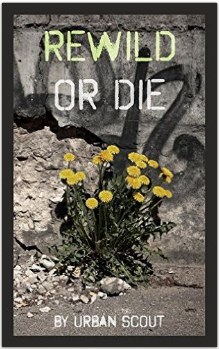
*This is an appendix in my book Rewild or Die*

Not A Penny To My Name

A lot of things have changed since the last time I posted an inconsequential blog, so here goes; I’m broke, single and living back with my parents in Molalla. I haven’t written in a while because I feel like I have nothing to say at the moment, but I know I have lots. For the last couple of months I’ve been crossing my fingers hoping to get on a reality tv show that I auditioned for. I didn’t get on it, for better or worse. I’d like to give you a daily snippet, but I don’t really have a typical day. So here is a mosaic of my days blended together.

So I’ve been doing a lot more production work again. I love it, even though it has nothing to do whatsoever with rewilding. With Penny Scout and I broken up, I’ve taken it upon myself to learn more about herbal medicine making since she did that for both of us. Now I’ll have to make it up myself. I’ve picked up my banjo again and have been playing until my fingers bleed. Okay, not really but practically! I finally got around to sewing this pair of wool pants but then I accidentally shrunk them in the wash. My book is basically done. I have no idea what to do now with it. I want to revise the focus of the rewild camps, moving away from the skill-share to the social-networking aspect, but I don’t have the time, inspiration or the resources to work on that right now.

I always feel a little lost, and although I feel very lost right now, I also feel like I’m more myself than I have been in years. Stay tuned for more bullshit.

“Energy Crisis” Vs. Rewilding

I keep hearing people say we’ve got an energy crisis. This carries a few bullshit premises. The most obvious premise here: that we need “energy.” Why do we need energy? What does it do that’s so fucking important? Humans lived for millions of years without electricity. Indigenous hunter-gatherers had no need to create it. It requires an entire industrial economy that inherently destroys the land in order to create it. It does not make humans lives easier; it simply gives the rich more power and more destructive tools. How many people in the world even have electricity? We don’t need “energy.” At least not in the way they mean it. The energy crisis, as well as the economic crisis, really means that rich people continue to lose power, and they have so brain-washed us that we believe we need to do our part to keep the pyramid strong, our slavery in place. Civilization uses energy to take even more than we could without it. The less energy civilization has, the more limits it has to grow. That seems pretty fucking fantastic to me.

Nature provides all the energy we need in a sustainable way, as proven by 3 million years of human hunter-gatherers living on this planet without fucking it up. Think about the energy that hunter-gatherers used; seal blubber candle vs. light bulbs. Wood cooking fire vs. gas stove. Not only did hunter-gatherers have smaller scale societies (because they didn’t have agriculture induced population growth problems) but their energy usage came from “renewable” sources. They used the sun to dry food and wood to generate heat in the cold. This burning helped to break down the  nutrients and minerals in the wood and make them readily available to fungi and bacteria. It also prevented the insanely destructive, large-scale forest fires we see today.

Without cheap oil or coal to generate the electricity and machinery, the industrial economy cannot exist. They call it “industrial” because machines (slaves, drones, robots) make it up, not people. Before industrial machinery, those in power used people. But it takes a slave with a stick a lot more time and energy to till a field than a farmer in his tractor. This excess of energy created the urban class of people, to manage the wealth (for the wealthy) created by these new machines. Real renewable energy does not mean a solar powered industrial economy. It means small-scale societies using hand-made tools (crafted from non-industrial materials) to encourage more biodiversity.

I don’t mean to say that everyone “should” stop using electricity and gas and everything. As long as you recognize you won’t have it forever, and as long as you use that excess energy to bring down civilization and promote cultures of rewilding. I use this computer, cell phone, cars, etc. etc. to educate people on how to live without them, and encourage them to stop these systems from destroying the planted. Remember, “green” technology doesn’t mean more sustainable” but “less destructive.” And more often it really means, “we’ve re-framed our marketing to pull the focus away from what we destroy, to point out what we don’t destroy so that you’ll forget that we continue to fuck shit up.”

I refer to the crisis that we really have going on as the “Bullshit Crisis.” Everyone listens to this civilized bullshit and just takes it in without question and the world continues to suffer. That looks like the real fucking crisis to me. The only crisis that matters is the Ecological Crisis. This crisis only exists because we have an economy and energy. The economic crisis means the end of growth, which means the end of excessive consumption which means the begining of the end of the ecological crisis. Fuck industrial energy, fuck the hierarchical economy, fuck this bullshit.

• Read more chapters from my book “Rewild or Die”

Hipsters Vs Rewilding

Can everyone shut the fuck up about “hipsters” already? I’m so fucking sick of that word. The whole subject seriously bores the shit out of me and yet I constantly have to defend myself from people who call me that word as though it suddenly makes everything I have done to further rewilding insincere or fake. I usually shrug it off but i recently surfed to the Adbusters website only to see an entire “feature” article from last summer where they just talk all kinds of shit about hipsters, and now I feel I need to say something.

The first time I got called a hipster I was walking into a burrito place on Belmont Street. As I walked through the door this big biker-looking dude was ushering out his 4 year old son. He said to his son with disgust, “Watch out for the hipster.” I remember feeling angry at first thinking, “I’m not a fucking hipster.” Of course I was. I was wearing a vintage Ferrari t-shirt, tight black polyester wranglers, black Ray-Ban sunglasses, black converse and I had a mullet. This was back in like, 2003.

When I was growing up, Portland was just another quiet, small, boring city on the west coast, always living in the shadow of Seattle and San Fransisco. Thanks to former mayor Vera Katz (who hated homeless people) the town is now littered with art galleries and fancy restaurants. 5 years ago  Portland was all of a sudden an up and coming arts town; it was super cheap to live here, people drank PBR because it was the cheapest beer, everyone under 30 was in a rock band and no one had ever heard of myspace or youtube.

I dropped out of high school at 16 to rewild. I took classes and spent most of time in the woods, the library or at work. I didn’t care much for the way I dressed; I wore mostly over-sized, military surplus wool clothes. I didn’t really care much about aesthetic at that point in my life because I had no culture. For the most part, I was a loner. I quit doing anything artistic (my passion was filmmaking) because I didn’t think that would help me learn to rewild. It wasn’t until I came across Joseph Campbell that I really began to see a purpose in my passion for art and cultural creativity. He said;

The function of the artist is the mythologization of the environment.

I realized that my artistic talents in filmmaking and other mediums could actually help create a cultural movement of rewilding by using art to spread the mythology of it. Lonely at 19, with no culture of rewilders, never having had a girlfriend before, I began to spend more time with people. I realized if I was ever going to create a culture of rewilding, I would need to blend in with the other artists in town, and subversively spread animism and rewilding from within the arts scene.

Luckily I had some really cool friends who I worked with at Coffee People to show me the ropes. We went to the Goodwill Bins and I got a new wardrobe in 2 hours for $5. This was back when the bins was only 39¢ a pound and before the over-priced “vintage” thrift stores began sending their employees there to pick all the good stuff so that they could then up-sell it. I would dig through the troughs of clothes, holding up shirts for my friend Dave and he would look at it and turn his head thinking, looking into it for its potential. Then he would explain whether or not it would work and why. It was like taking a class on how to see cool. Dave loves clothes and talking about aesthetics and his excitement and knowledge spilled over into me. With Dave’s help I acquired my first girlfriend, Elspeth, a seamstress & clothing designer who took me a few steps further, with understanding how to dress oneself for their particular body and her classic motto, “it works if you work it.” With their help, I became a hipster fashionista practically over night.

I can hear you all saying, “what a poseur!” Let’s talk about that for a second. When I was in high school I remember this one time I walked by the most gothic kid in our school and I overheard him saying, “Then this guy was like, ‘Get outta my way you goth!’ and I was like… Oh my god! I’m not gothic!” I remember thinking, “what the fuck is that guy talking about. He is obviously gothic.” I knew immediately what he was doing; it isn’t cool to “try” to look gothic. To talk about yourself as gothic would mean you were intentionally going out of your way to dress like that and it’s never cool to admit it, because caring about shit is not cool. .

I recently pointed out to a green anarchist who claimed he “dressed however he wanted” that he wore all the right green anarchist scene clothes and topped it off with their iconic dreadlocks. By admitting I chose to dress this way, I’m no longer cool because it’s also not cool to “follow the crowd.” If being punk or gothic or hipster or anarchist is an attempt at rebelling against the mainstream, than being labeled a hipster is saying that you are a follower of a fashion trend and not a creative individual. Let’s get real. No one dresses like an individual. No one accidentally dresses like a gutter punk, hipster, hippie, yuppie, or whatever. Everyone chooses their subcultural identity. There is no way you can dress that will not lump you in with some kind of crowd. Subcultures create aesthetics. The individuality comes out of how you express yourself in that particular subculture. If you’re a gutter punk, you’ll obviously have a studded jacket, but the placement of studs or even the words you write on the jacket expresses your own individuality within that culture.

In the years that followed I made a lot of friends, partied my ass off and forgot all about why I became part of that subculture. In 2008, Portland is now like Seattle’s once cooler punk rock cousin, that finally had to get a job. In other words, the party is over. Shit is now extremely expensive in Portland and there are no jobs. I’ve seen the small town turn into a huge, strung out city practically over-night. I’ve lived through, been part of, and learned a tremendous amount about, the rise of hipster culture. I will risk my cool and admit that I am a hipster.

The best part of all is that these “critiques” of hipster culture never come from the hipster community speaking for itself, it’s always an outsider talking about something they are not a part of and don’t understand because they are either too old, jealous, or more self-conscious, then the hipsters they claim are. I (usually) don’t hear my hipster friends talking shit about people who aren’t in that scene. I’ve probably heard a dozen or more people who I don’t consider hipsters say, “Look at those fucking hipsters over there. They think they’re so fucking cool.” You know what? I bet those “hipsters” didn’t even notice you. Why the fuck do you care? Why do you go out of your way to point them out?

The largest criticism of hipster culture is that we allegedly steal symbols and styles from previous cultures but without the authenticity or sincerity with which those cultures had. Firstly, every new subculture steals from an older one. This is what old people say every time a new subculture rises. “They’re stealing from us!” Generally it’s because the old people don’t feel appreciated or acknowledged for “creating” (even though they stole it from someone else) that particular style. Secondly, in terms of the “lack of authenticity” or sincerity, every culture adapts and alters an old style and gives it a new meaning. While people complain about hipsters lack of sincerity and lack of meaning, that’s just our “new” twist.

Urban peoples lives are pointless; we are the human waste product of agriculture. We have no integrated purpose in the context of the real, wild world. We have no relationship with our landbase, except blind exploitation. Our purpose is only to serve coffee to those in power, to enter data into spreadsheets for those in power, or operate machinery for those in power. We simply shift wealth around so that we feel like we’re doing something. Though we are drowning in culture, none of it has any meaning beyond its initial consumption. Our entire culture is disposable. Our lives are disposable.

Some have made claims that we hipsters are lame because unlike previous counter-cultures, we do not rebel against previous generations. I think hipsters are rebelling against previous generations; we are rebelling against meaning. The people of my generation have all seen what those in power do to people with feelings and ideas. We’ve seen the gamut of “revolutions” and we have seen that they mean nothing in the end. Civilization continues to kill all life on this planet no matter who is in charge, no matter how much we protest, this culture wins and the earth dies. No matter what we do, we are slaves to it; we’ve been conditioned to be pacifists from birth. Rather than look foolish like our “revolutionary” predecessors, we just stopped caring at all, accepting our slavery to find happiness in novelty, irony, drugs, sex and music. Hipsters are not lame for being apathetic; civilization is lame for destroying our lives, our hearts and our landbase.

If meaninglessness is cool now, it will not be cool tomorrow. I want to break the shackles of this hierarchy and create a living world. I’m determined to make rewilding the next counter-culture. Who’s with me?

Ask Urban Scout #10

Dear Scout,
I can’t help but get the feeling that you are advocating for all 6 billion people to go back to living as hunter-gatherers. Wouldn’t that quickly deplete all of the wild food out there? Wouldn’t all 6 billion of us quickly eat up the wild? How many salmon are left? If all of us started eating salmon exclusively, they would go extinct that much faster. What do you think about this?

I get this question quite often and my answer is yes, I think that all 6 billion of us should immediately stop farming and start hunting/gathering/gardening for our food. Hunter-gatherers didn’t just kill things and eat them without any foresight the way modern “sport” hunters do. They had complex systems of land management that built soil and created mosaics of habitat, maximizing biodiversity for small areas. This is why I say over and over again that you can’t just throw on some buckskin clothes, grab a bow and arrow and think you’re a hunter-gatherer. The tools are meaningless without the system that created them. Civilized people wore buckskin and hunted with bows and arrows for thousands of years. The management system of hunting and gathering is the real technology. Not the hand-made artifacts they leave behind, but the ecological artifacts like salmon runs so thick you couldn’t walk through the river.

Civilized people do not understand that hunting and gathering means giving back more than you take. If everyone were to start giving back more than they take, we’d actually begin to build biodiversity and wild food sources back up. Sure, the dams have killed the salmon, and if all of us became hunter-gatherers that means we would become stewards of the salmon which means we would dismantle the dams and build spawning habitats along the river banks.

- Scout

If you have a burning question for Urban Scout, send him an e-mail at urbanscout [at] gmail [dot] com with the subject, “ask urban scout.”

Living Christmas Tree

Rewilding Mentioned in Adbusters

My friend Josh tipped me off today that the latest issue of Adbusters has an excerpt from the Positive Living Magazine issue that featured me in an article.